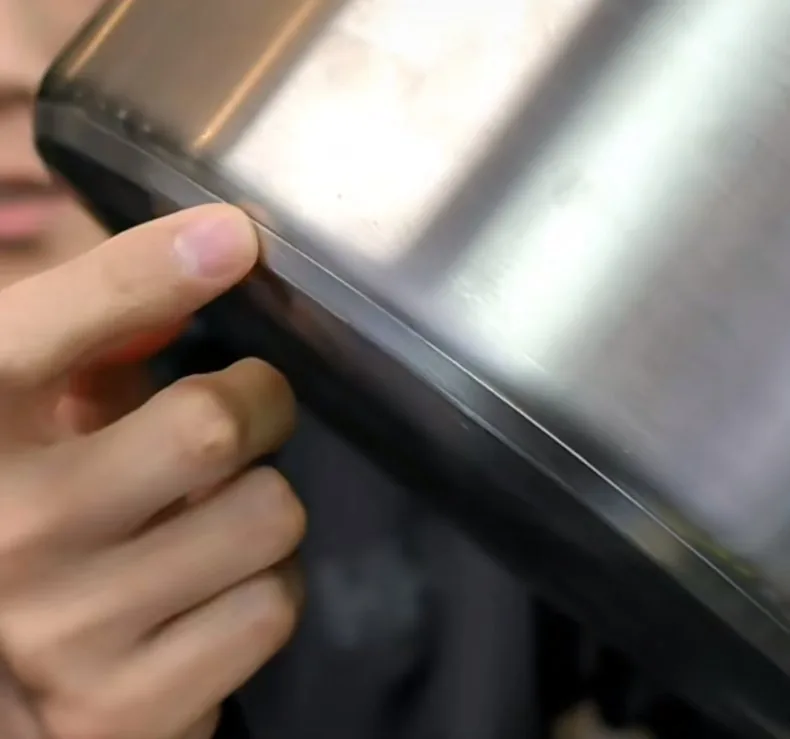
In July, a shopper in Suzhou bought a stainless steel pressure cooker. On 1 October, mid-way through cooking rice, there was a bang — and the composite base had sheared clean off the pot. Online, the case was far from alone. Reports of cookware bases letting go have accumulated for years, and one premium German brand — whose name translates, ironically, as "twin" — has been photographed with the entire bottom separated, which amused netizens promptly renamed "single".
So why does even expensive cookware lose its bottom? The short answer: almost every stainless steel pan on the market is not one piece of steel. It is a composite — and composites fail at the joint. This guide covers the construction (fully clad vs disc-bottom), the bonding methods behind it, the four ways a base fails, and how to check your own pots at home. If you are sourcing cookware rather than shopping retail, the factory checks at the end are the part that matters.
Single-layer stainless steel cookware exists, and it is not good. The problem is physics. Stainless steel is a poor conductor of heat — roughly an order of magnitude worse than aluminium and twenty-five times worse than copper:
| Metal | Thermal conductivity (W/m·K) | Role in cookware |
|---|---|---|
| 304 / 316 stainless steel | ~15–16 | Cooking surface and shell (your pan's body) |
| Titanium | ~15–22 | Same league as stainless — not a conductor either |
| Aluminium | ~205–237 | The standard conductive core |
| Copper | ~385–400 | Premium cores, fastest response |
Put a single-layer stainless pan on a flame and the centre can race past 300 °C while the rim sits near 100 °C. Food burns in the middle and stays raw at the edges — and a pan that thin warps under the strain. There is a second, quieter problem: the 304 and 316 grades that make stainless food-safe are austenitic, which means they are essentially non-magnetic. A plain 304 or 316 pot will not heat on an induction cooktop at all. (This is exactly why induction-ready pans carry a magnetic 430 layer — see our 304 vs 430 stainless steel comparison.)
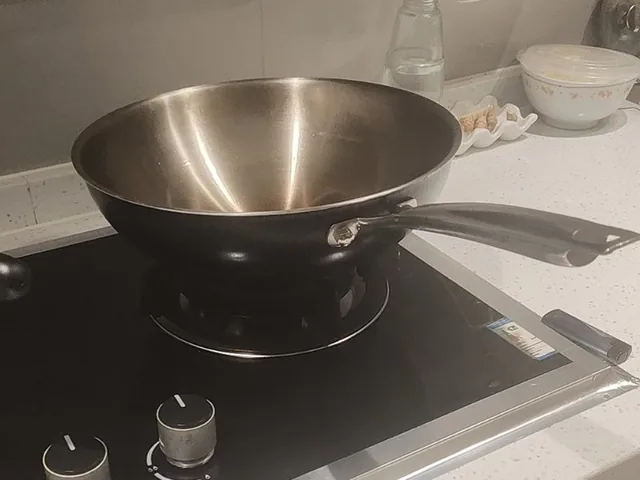
The industry answer is to marry stainless steel to a conductive metal: bond an aluminium or copper core to a stainless shell so heat spreads evenly while the cooking surface stays inert and durable. That bonded structure is called cladding, and every stainless pan you own is some version of it.
Clad cookware comes in two dominant forms, and they are not the same product.
Disc-bottom cookware — also sold as "impact-bonded base", "encapsulated base" or "sandwich bottom" — bonds a disc of conductive metal to the base of an otherwise single-layer stainless body. The disc does its job on the floor of the pan; the sidewalls stay thin single-ply steel and barely share the heat. A magnetic 430 cap is often added to the underside for induction.
Fully clad cookware — tri-ply, 5-ply, multi-ply — runs the layered sandwich through the entire vessel, base to rim: stainless / aluminium / stainless, with premium lines adding copper or extra layers. Because the core reaches the walls, the whole interior surface conducts and food cooking against the sides heats at the same rate as food in the centre.
You can usually tell which one you are holding:
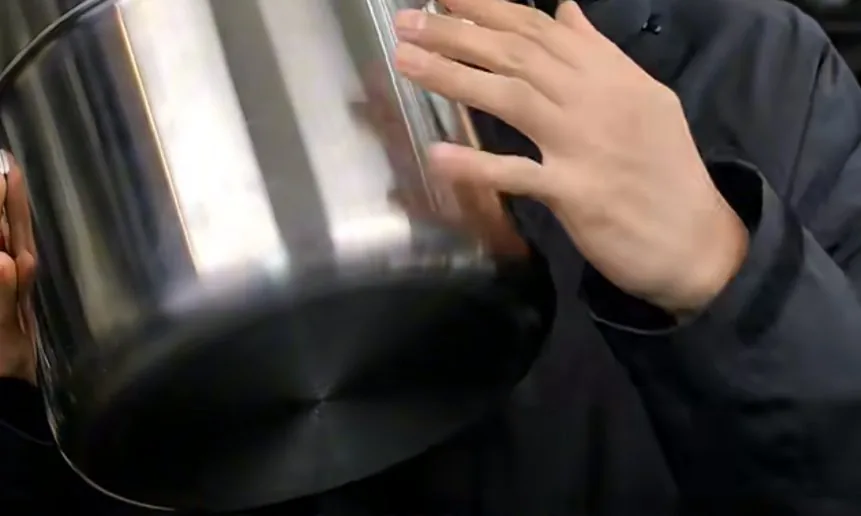
Neither construction is automatically better — the right choice depends on the vessel. For stockpots, pasta pots and kettles, where water does the distributing and the walls do no cooking, a disc bottom is entirely sensible and saves money and weight. For sauté pans, sauciers and frying pans, where food touches hot walls all day, fully clad earns its premium. Our own tri-ply frying pans are fully clad for exactly this reason.
The visible difference between two pans is construction; the invisible difference is the bond. Three processes join stainless steel to aluminium, and they are not equivalent:
| Method | Bond strength | Cost | Core thickness tolerance | Best for |
|---|---|---|---|---|
| Explosion welding | ≥80 MPa | Highest | ±0.1 mm | Premium cookware, extreme use, EU/US export |
| Roll bonding | 60–80 MPa | Medium | ±0.2–0.3 mm | High-volume standard production |
| Brazing | 30–50 MPa | Lowest | ±0.2 mm | Small batches, custom-shaped bases |
Explosion welding and roll bonding produce a metallurgical bond — the metals are fused into one laminate with no filler, so the joint is as permanent as the metals themselves. Explosion welding uses controlled explosive force to slam the layers together at high velocity; roll bonding passes stacked sheets through heavy rollers at 300–450 °C. Both yield fully clad sheet, which is then formed into pans.
Brazing is different: a silicon-aluminium filler is melted between the layers and solidified. It is the only method that handles odd shapes and small runs economically, which is why it is the standard process for disc bottoms — and it carries two risks the other two do not. First, the 620–680 °C brazing cycle overlaps the stainless sensitization range (450–850 °C), where chromium carbides can precipitate at grain boundaries and permanently reduce corrosion resistance. Second, the filler itself is less corrosion-resistant than the base metals, so any micro-crack in the cladding lets corrosion travel along the bond line.
Keep one sentence from this section: the pans that lose their bottoms are usually brazed.
Insufficient bond coverage and porosity in the brazed layer are the root cause of most "the bottom just fell off" stories. A "tri-ply" stamp on the box says nothing about the bond rate underneath — two pans with identical stamps can differ by a factor of two in joint strength.
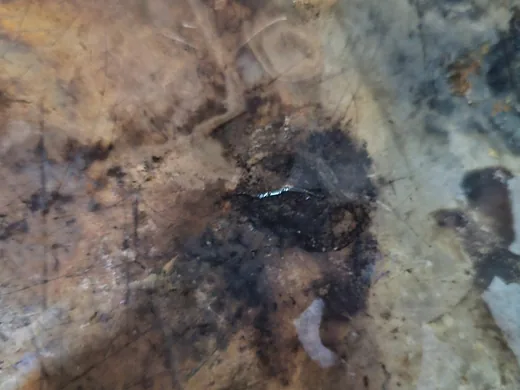
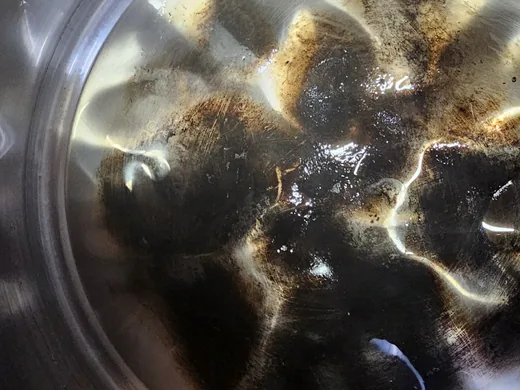
The most common failure in daily use. An empty pan left on high heat — or a burner smaller than the base, concentrating heat in the middle — pushes local temperatures past the point where the aluminium core (melting point 660 °C) softens. Once the core softens, the two metals' expansion mismatch works the joint open, and the base separates. We reproduced exactly this in our own workshop: a composite-base pot left on a high burner until the core gave way. The scorch pattern below is the signature of that failure.
Dishwasher tablets are alkaline by design, and alkaline cleaners attack aluminium. The hot, wet cycle also stresses the bond line chemically and thermally. Frequent dishwashing is a slow-motion version of cause 2 — which is why most premium manufacturers specify hand washing (our dishwasher safety guide covers the full picture).
The rim seam is the usual entry point. Repeated thermal cycling opens hairline cracks at the edge, water creeps in, corrosion works along the interface, and the gap grows cycle by cycle until the base lets go. This is the version that takes years — and the one a 30-second home check can catch early.
You do not need lab equipment to find a weak base. Three checks, one minute:
Tap around the base, ring by ring, with a knuckle or the back of a spoon. A healthy composite base rings consistently. A spot where the sound suddenly turns dull and dead is a void — the layers have already separated there.
Pour a thin film of water into the pan and heat it. If bubbles rise evenly across the whole base, the composite is bonded and conducting uniformly. If bubbles cluster in patches — or an infrared thermometer reads visibly different temperatures across the floor — those positions have a bonding problem.
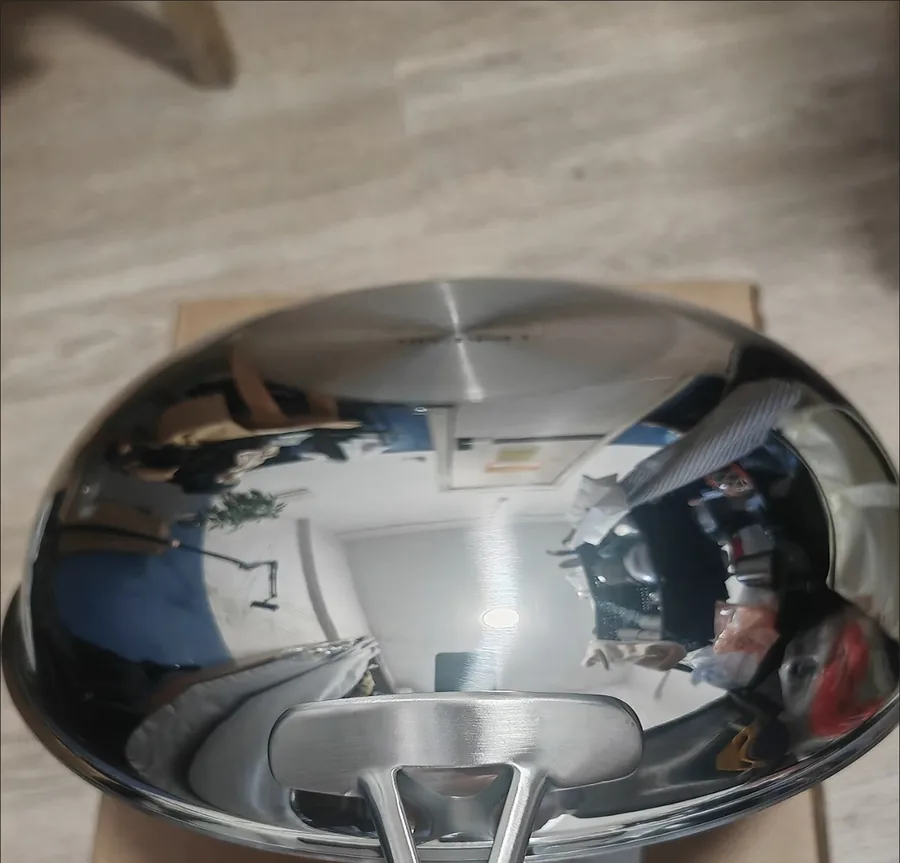
Inspect the cut rim for layer striping and the wall-to-base seam for a step or ring (see the section above). Then place the pan upside down on a flat counter: if it spins freely or rocks, the base has already warped. A teaspoon of oil in the centre tells the same story — oil that runs to one edge means a concave base.
Most base failures are preventable. A short list of habits keeps a composite bottom intact for years:
If you are buying rather than caring, specify by construction, not by layer count. For pans you actually cook in — sauté pans, sauciers, frying pans — ask for fully clad construction, roll-bonded or explosion-welded, and make core thickness and bond-rate test data part of the spec rather than the ply number on the box. For stockpots and kettles, disc-bottom is a rational, cheaper choice and no one should pay clad prices for it. Our 304 stainless frying pans and saucepan and soup pot sets are built to exactly these two rules.
No — they are built for different jobs. A disc-bottom pan concentrates conductive metal at the base, which is all a stockpot, pasta pot or kettle needs, since water distributes the heat. It is a poor choice for a sauté pan or frying pan, where food touches the sidewalls and only a fully clad body heats them evenly. Match the construction to the vessel instead of paying for layers you do not use.
Only if it has a magnetic layer. The 304 and 316 grades (18/10) are austenitic and essentially non-magnetic, so a plain stainless pot will not heat on an induction cooktop. Manufacturers bond a ferritic 430 stainless layer to the base — which is one more reason the base is a composite, and one more interface that can fail if it is brazed poorly. Our 304 vs 430 guide explains the grades in detail.
No — stop using it. A partially delaminated base heats unevenly, exposes aluminium to food in the worst case, and can let go entirely on a hot burner, which is both a burn risk and a ruined dinner. The tap test tells you early: treat any dull, dead spot as the end of that pan's service life.
Explosion welding. It creates a true metallurgical bond with no filler, rated at 80 MPa and above, and it survives thermal and mechanical shock that would open a weaker joint. Roll bonding follows at 60–80 MPa and is the standard for high-volume production; brazing is weakest at 30–50 MPa but remains the right tool for custom shapes and small runs.
Send us your target construction, core thickness and market — we reply within 24 hours with a specification, pricing and a realistic production schedule.
Request a quote WhatsApp us